Beginner's Guide to Reading a Bazi Chart
Nov. 29, 2025
New to BaZi? This simple step-by-step guide helps you read a chart with confidence — starting from your Day Master to the key elemental relationships that shape your destiny.
Bazi, also known as the Four Pillars of Destiny, is an ancient Chinese metaphysical system that analyzes a person's destiny based on their birth date and time. Think of it as a cosmic DNA that reveals personality traits, strengths, weaknesses, and life patterns. This guide will help you understand how to read a basic Bazi chart.
Understanding the Chart Structure
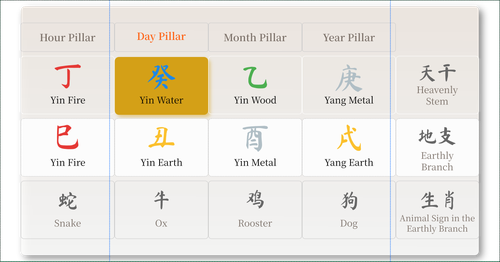
A Bazi chart consists of four pillars, each representing a different aspect of your life:
- Year Pillar: Your roots, ancestry, early childhood (ages 0-15), and relationship with grandparents and society
- Month Pillar: Your core self, parents, early adulthood (ages 16-30), and career foundations
- Day Pillar: Your inner self and marriage palace—the Heavenly Stem of the Day Pillar is your Day Master and represents YOU. The Earthly Branch of the Day Pillar represents your spouse
- Hour Pillar: Your children, legacy, later life (ages 45+), and what you leave behind
Each pillar has two components stacked vertically:
- Heavenly Stem (top): The visible, external energy—what the world sees
- Earthly Branch (bottom): The hidden, internal energy—your deeper nature and hidden influences
The Five Elements
Everything in Bazi revolves around five elements and their interactions:
- Wood (木) : Growth, creativity, flexibility
- Fire (火) : Passion, transformation, visibility
- Earth (土) : Stability, nurturing, grounding
- Metal (金) : Structure, determination, refinement
- Water (水) : Wisdom, flow, adaptability
Each element also has a polarity:
- Yang : Active, external, masculine energy
- Yin : Passive, internal, feminine energy
The Example Bazi Chart
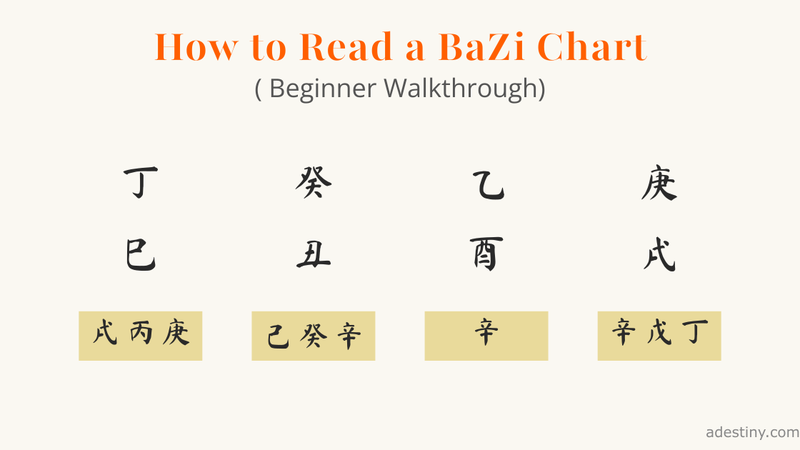
We will use the following chart in our analysis. However, if you wish to also follow along with your own chart, use the free tool here:
👉 Free Bazi Calculator
Step 1: Identify the Day Master
The Day Stem is the most important element—it represents YOU. In this chart, the Day Master is 癸 (Gui ), which is Yin Water.
Yin Water people are like gentle rain, mist, or dew. They are :
- Intelligent and resourceful
- Adaptable and flowing
- Sometimes overly sensitive or worrisome
- Capable of nourishing others quietly
Everything else in the chart must be interpreted relative to Yin Water.
Step 2: Analyze Element Distribution
Count the elements in the chart:
- Water : 2 (Day Stem 癸, hidden in Day Branch 癸)
- Metal : 6 (Year Stem 庚, Month Branch 酉, hidden 辛 in Year/Month/Day Branches, hidden 庚 in Hour Branch)
- Fire : 3 (Hour Stem 丁, Hour Branch 巳, hidden 丙 and 丁)
- Earth : 3 (Day Branch 丑, Year Branch 戌, hidden 戊 and 己)
- Wood : 1 (Month Stem 乙)
This chart is extremely Metal-heavy with strong Earth support. Since Metal produces Water (the Day Master), this person receives overwhelming support from resources and helpful people. However, such strong Metal could also create an imbalance that needs attention.
Step 3: Understand the Hidden Stems
The Earthly Branches contain hidden stems—think of them as the "roots" beneath the surface:
- 巳 (Si/Snake) : Contains 戊 Yang Earth, 丙 Yang Fire, 庚 Yang Metal
- 丑 (Chou/Ox) : Contains 癸 Yin Water, 己 Yin Earth, 辛 Yin Metal
- 酉 (You/Rooster) : Contains 辛 Yin Metal
- 戌 (Xu/Dog) : Contains 辛 Yin Metal, 戊 Yang Earth, 丁 Yin Fire
These hidden elements reveal deeper influences on the person's character and life circumstances.
Step 4: Examine Element Relationships
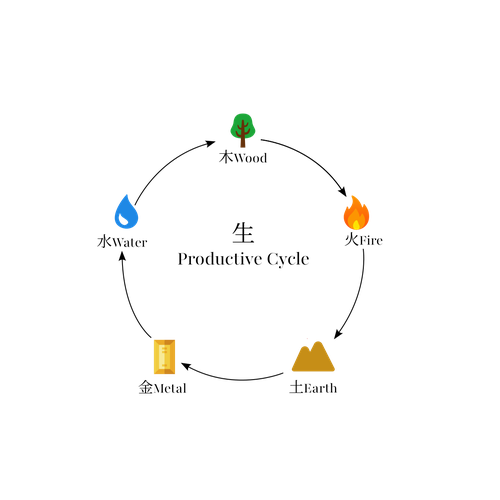
Elements interact through the Production Cycle :
and the Controlling Cycle :
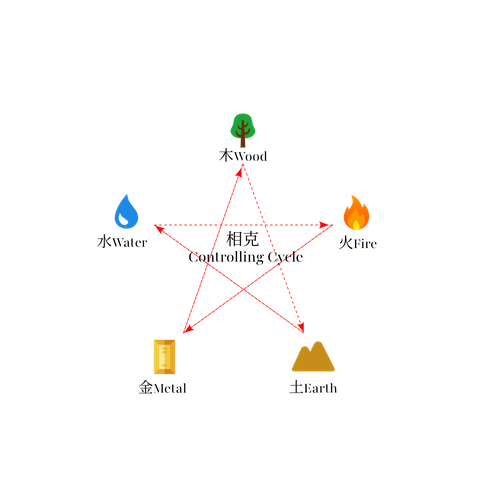
In this chart:
- The Day Master (Yin Water) is strongly supported by abundant Metal, which produces Water
- Wood is weak (only one Yin Wood), meaning this person may need to cultivate growth and expansion
- Fire is moderately present, controlling the Metal excess
- Earth (representing Wealth for Water) is strong, indicating potential for material success but possible overwhelm
Step 5: Identify the Ten Gods
Each element in the chart has a relationship to your Day Master, creating the "Ten Gods"—archetypal energies:
For a Yin Water Day Master:
- Metal = Resource (support, knowledge, mother)
- Water = Friend/Companion (peers, competition)
- Wood = Output (creativity, children, expression)
- Fire = Wealth (money, father, desire)
- Earth = Officer (authority, career, discipline)
In this chart:
- Strong Resource (Metal): This person has excellent learning ability, strong support systems, and possibly a protective mother figure
- Strong Officer (Earth): Career-oriented, disciplined, but may face pressure from authority or societal expectations
- Weak Output (Wood): May struggle with self-expression or need to work harder to showcase creativity
Key Insights from This Chart
- Well-resourced individual: The abundance of Metal supporting Water suggests someone with strong backing, good education, and helpful mentors throughout life
- Career pressure: Strong Earth (Officer) means career responsibilities and social expectations play a major role—possibly a serious, duty-bound personality
- Balance challenge: With weak Wood (Output/Expression), this person might feel constrained in expressing themselves freely, despite having much knowledge and support
- Wealth potential: Fire (Wealth) is moderately strong, suggesting financial opportunities, especially through disciplined career efforts
- Marriage palace analysis: The Day Branch 丑 (Ox) is Yin Earth with hidden Water and Metal—the spouse may be practical, stable, and supportive, though the relationship requires managing work-life balance
Tips for Beginners
- Start with the Day Master: Always identify your core element first—everything relates back to you
- Look for balance: A balanced chart has all five elements present in moderate amounts. Imbalance isn't bad—it just shows where life themes emerge
- Consider seasonality: The month you're born in affects element strength. This chart is born in the Metal month (酉/Rooster, autumn), amplifying Metal's power
- Don't judge: No chart is "good" or "bad"—each reveals unique patterns and potential paths
- Seek context: Bazi is just one lens. Combine it with personal growth, free will, and life experience
Next Steps in Your Bazi Journey
- Learn about the 12 Life Stages (growth cycles of elements)
- Explore Luck Pillars (10-year cycles revealing life chapters)
- Study clash and combination relationships between branches
- Understand the concept of Useful God (the element that brings balance)
Remember: Bazi is a tool for self-awareness, not a fixed fate. Understanding your chart empowers you to work with your natural tendencies and navigate life's challenges with greater wisdom.