The Ten Gods — The Ten Aspects of Your Life
Dec. 13, 2025
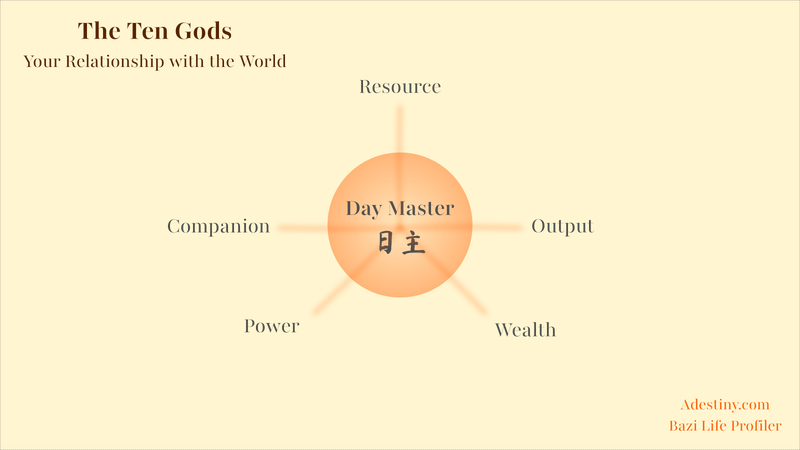
The Ten Gods explain how your Day Master interacts with the world — through relationships, responsibilities, opportunities, and challenges. This article presents the Ten Gods in clear, modern terms, showing how they reflect real-life roles rather than abstract labels.
Once you understand your Day Master, the next question naturally follows:
How do I relate to the world around me?
In BaZi, the answer lies in the Ten Gods (十神).
Despite their traditional name, the Ten Gods are not religious or mystical beings. In modern terms, they can be understood as the ten key aspects of your life — the different ways your core self interacts with people, responsibilities, opportunities, and challenges.
To understand the Ten Gods properly, you first need to understand your Day Master — the element that represents your core self in BaZi.
If you’re new to this concept, you may want to start with this article:
How Your Day Master Shapes Who You Are.
A Modern Way to Understand the Ten Gods
In today’s language, you can think of the Ten Gods as the ten life roles or life themes that shape your experiences.
They describe:
- How you learn and receive support
- How you express yourself
- How you handle work, authority, and responsibility
- How you deal with money and resources
- How you interact with peers, competition, and collaboration
Your BaZi chart shows how these ten aspects relate to your Day Master, which represents your true self.
How the Ten Gods Are Formed
The Ten Gods are derived from the relationship between:
- Your Day Master (Day Stem)
- The other Heavenly Stems in your BaZi chart
Each relationship is defined by:
- The Five Elements (Wood, Fire, Earth, Metal, Water)
- Yin and Yang polarity
Depending on whether an element:
- Supports your Day Master
- Is produced by your Day Master
- Is controlled by your Day Master
- Controls your Day Master
- Is the same as your Day Master
… it becomes one of the Ten Gods.
The Ten Gods in Relation to the Day Master
In BaZi, the Ten Gods are not random labels applied to chart elements.
They are defined entirely by their relationship to the Day Master — your core self.
Every Heavenly Stem and Earthly Branch in the chart either:
- supports the Day Master,
- challenges it,
- draws energy from it, or
- reflects it.
These interactions form five fundamental life forces, all revolving around the Day Master, as shown in the diagram below.
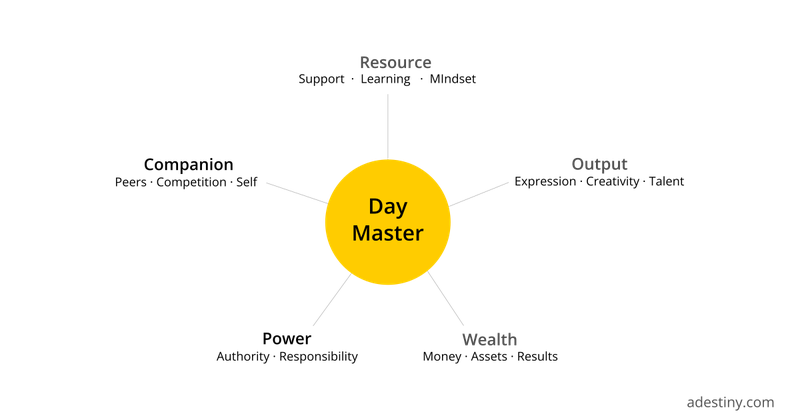
The Ten Gods revolve around the Day Master, forming five core life forces that describe how an individual interacts with the world.
Rather than interpreting the Ten Gods one by one in isolation, it is more accurate — and more useful — to see them as a structured system centered on the Day Master.
The Five Core Life Relationships (Ten Gods in Pairs)
Although there are ten in total, the Ten Gods fall into five pairs, each representing a major aspect of life.
1. Resource ( 印 ) — Learning, Support, Inner Security
Resource represents how you are supported in life.
This includes:
- Learning and education
- Mentors and guidance
- Emotional nourishment
- Inner stability and reflection
People with strong Resource tend to value knowledge and preparation. When excessive, it can lead to overthinking or hesitation.
Forms:
- Proper Resource (正印)
- Indirect Resource (偏印)
2. Output (食伤) — Expression, Creativity, Talent
Output represents how you express your inner self outwardly.
This includes:
- Creativity and ideas
- Communication
- Skills and talents
- Self-expression
Strong Output often indicates creativity, articulation, and the desire to be heard. When imbalanced, it can show impulsiveness or friction with authority.
Forms:
- Eating God (食神)
- Hurting Officer (伤官)
3. Wealth (财) — Resources, Results, Responsibility
Wealth represents how you manage resources and results.
This includes:
- Money and material resources
- Practical outcomes
- Responsibility in relationships
- Long-term stability
Strong Wealth often shows practicality and responsibility. Excessive pressure in this area can lead to stress or burnout.
Forms:
- Proper Wealth (正财)
- Indirect Wealth (偏财)
4. Power — Structure, Discipline, Authority
Power represents structure and responsibility in life.
This includes:
- Rules and discipline
- Authority and leadership
- Career responsibility
- Social expectations
Balanced Power brings reliability and leadership. Too much may feel restrictive, while too little may lead to lack of direction.
Forms:
- Proper Officer (正官)
- Seven Killings (七杀)
5. Companion — Self, Peers, Competition
Companion represents your relationship with equals.
This includes:
- Friends and peers
- Collaboration and competition
- Independence and self-confidence
- Shared resources
Strong Companion energy often shows confidence and initiative. When excessive, it may indicate rivalry or difficulty sharing.
Forms:
- Friend (比肩)
- Rob Wealth (劫财)
The Ten Gods Are Not Good or Bad
A common misunderstanding is to label certain Ten Gods as “good” or “bad.”
In reality:
The Ten Gods simply describe which aspects of life are emphasized and how they interact with your Day Master.
A healthy BaZi chart usually shows balance, allowing you to:
- Learn when needed
- Express yourself appropriately
- Take responsibility
- Manage resources
- Cooperate or compete wisely
Why the Ten Gods Are Personal
One important point for beginners:
The same Ten God behaves differently for different Day Masters.
For example:
- Wealth may feel natural and motivating for one person
- The same Wealth energy may feel draining for another
This is why BaZi analysis is always personal and contextual, never generic.
Seeing the Ten Gods in Everyday Life
In daily life, the Ten Gods are always active:
- Studying or seeking advice → Resource
- Creating or speaking → Output
- Earning or managing money → Wealth
- Taking responsibility → Power
- Competing or collaborating → Companion
Your BaZi chart simply shows which of these aspects come naturally to you and which require conscious effort.
What Comes Next?
In the next articles, we will explore:
- Which Ten Gods are strong in your chart
- How different Day Masters experience the Ten Gods
- How luck cycles activate different life aspects
- Real-life examples of Ten Gods in action
Understanding the Ten Gods brings BaZi from theory into practical, everyday insight.